


Refractory Anchors
In recent years, refractory ceramic fibers have been used in a wide range of fields, including various industrial furnaces, petrochemical-related facilities, cement manufacturing facilities, and waste incinerators, etc. Refractory anchors are reinforcing hardware for holding and securing insulators.
There are various shapes of refractory anchors, including “V-shaped,” “Y-shaped,” and “corrugated” anchors, depending on various applications. The selection of anchor material, size, and shape varies depending on the refractory construction thickness, construction method, and operating temperature.


Metallic Anchors
Metallic anchors specially stainless steel, are one of the most common anchoring systems due to their low price and easy installation, and a combination of metal and ceramic anchors is used at high temperatures. The thickness and dimensions of metal anchors depend on the type of refractory material and working temperature.
Ceramic and Ceramic fiber Anchors
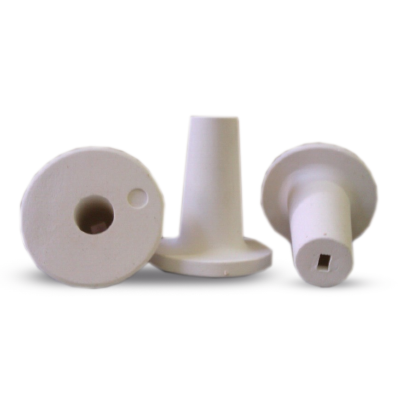
use of ceramic anchors is recommended if the refractory layer is under very high operating temperatures or there is a risk of chemical corrosion. Ceramic anchors are used in the walls, ceiling and front of the furnaces to maintain the refractory layer. Anchoring for refractory work using ceramic fibers in the distance between the metal wall of the furnace to the hot surface is performed by the locking anchor system. This minimizes the risk of insulating retainers of the first layer of high temperature furnaces. This system can be used as a holder for ceramic blankets, ceramic boards , refractory steel layers and all hard items without elasticity.
| Typical properties | Other(%) | Ni(%) | Cr(%) | Max Service Temperature(℃) | Material(DIN) | Material(AISI) |
| Good resistance to temperature and corrosion Sensibility to sigma phase embrittlement | 8-10 | 17-19 | 800 | 1.4301 | 304 | |
| Good resistance to Sulphur atmosphere Sensibility to sigma phase embrittlement | Si= Max 0.75 | 19-222 | 24-26 | 1050 | 1.4845 | 310 |
| Resistance to sigma phase embrittlement | Si=1.5-2.5 | 19-22 | 24-26 | 1150 | 1.4841 | 314 |
| Outstanding oxidation resistance Good resistance to Sulphur and nitrogen atmosphere | N=0.14-0.20 | 10-12 | 20-22 | 1150 | 1.4835 | 253Ma |