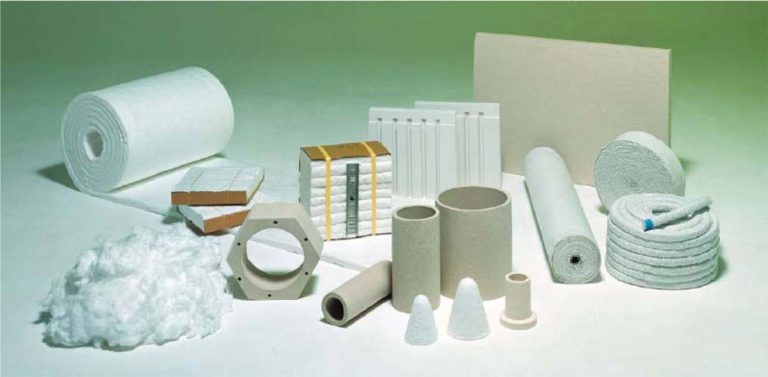
Characteristics of ceramic fiber
Ceramic fiber (CF) is a man-made mineral fiber consisting mainly of alumina and silica. Because of its exceptionally low thermal conductivity, ceramic fiber dissipates little heat from the furnace and has remarkable energy-saving properties In addition, because of its low density and low thermal inertia, ceramic fiber facilitates controlling the
temperature inside the reheating furnace. For those reasons, the ceramic fiber module (Z-block) has been increasingly used for the inner linings of various reheating furnaces at steel making plants, etc.
Types of ceramic fiber and manufacturing processes
Ceramic fibers are largely divided into vitreous alumina-silica ceramic fiber (vitreous ceramic fiber) whose service temperature is below 1,250℃ and crystalline alumina ceramic fiber (crystalline ceramic fiber) whose service temperature is above 1,250℃.
1- Vitreous CF manufacturing process
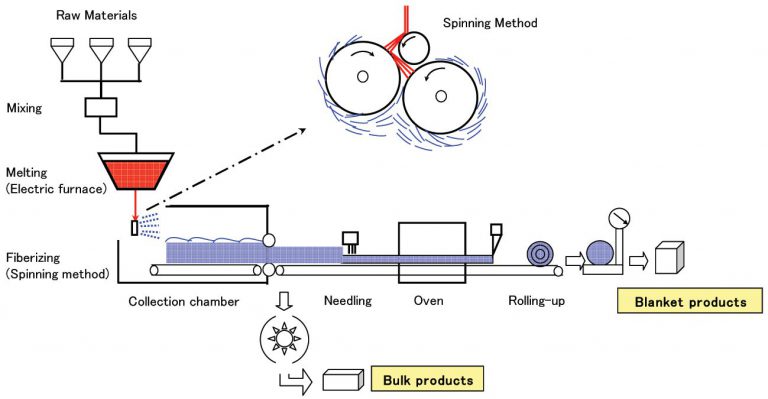
Vitreous CF is manufactured by the melting and fiber-making process. A mixture of raw materials—mainly alumina and silica—is melted at about 2,000℃. Thermal Ceramics, the molten mixture is ejected through a nozzle onto rotors turning at high speed and made into a bulk (raw fibers) by the centrifugal force of the rotors (spinning method). There is another fiber-making method in which the mixture of raw materials is blown by compressed air or steam (blowing method). A stack of bulks is lubricated and subjected to needling. The lubricant is then removed by heating to create a blanket.
The maximum service temperature of vitreous ceramic fiber differs according to its constituent raw materials. For example, there is a 1,260℃ grade made from high-purity alumina and silica or kaolin clay, and a 1,400℃ grade that is made from high-purity alumina, silica and zirconia
2- Crystalline CF manufacturing process
Since the molten raw material for crystalline CF contains a large proportion of alumina and has low viscosity, the melting & fibermaking process that is applied to vitreous CF cannot be used to manufacture crystalline CF. Therefore, a precursor fiber-making process is used to manufacture crystalline CF. In this process, a fiber precursor solution containing aluminum is spun at room temperature into precursor fibers, which are crystallized by baking at temperatures of 1,000℃ or higher and made into a bulk. A blanket is manufactured by subjecting precursor fibers to needling before they are baked.
3- Ceramic fiber products
The bulks and blankets mentioned above are processed into various types of fiber products. include ceramic fiber bulk, blanket and module (Z-block), which is widely used as a lining material for steelmaking equipment, is a module made by folding a blanket in the form of bellows and fitting metal supports to it. There are many other ceramic fiber products, such as sheets, boards, die-formed products that are specially shaped using a wet process, and ropes, tapes, and cloths, etc. by applying spinning technology.